Studies show that US coverage is Israeli-centric. The main bureaus for CNN, Associated Press, Time, etc. are located in Israel and often staffed by Israelis. The son of the NY Times bureau chief is in the Israeli army;"pundit" Jeffrey Goldberg served in the IDF; Wolf Blitzer worked for AIPAC. Because the U.S. gives Israel $7 million/day - more than to any other nation - we feel it is essential that we be fully informed on this region. Below are news reports to augment mainstream coverage.

Wednesday, March 10, 2010

Soldiers Attempt to Strip-Search Five Palestinian Women

IMEMC
Five Palestinians women preferred to go home rather than heading to an Israeli prison to visit their detailed family members after Israeli soldiers stationed at a Roadblock near the central West Bank city of Ramallah demanded to strip-search them.

Qaddoura Fares, head of the Palestinian Prisoner Society, stated at a press conference on Tuesday that this is one of the illegal means Israel is using to target the detainees and their families.

He added that the families of the detainees decided to strike for a month in April to protest the illegal Israeli measures. They will not be visiting their detained family members and would be holding protests in front of the Red cross.

Israel is also denying 1200 detainees from any visitations as they are classified as “security risk”...

Palestinian Minister of Detainees, Issa Qaraqe’, said that Israel is always trying to strip-search the families of the detainees, especially the women, and that such demands are mainly made at the prisons.
He added that this is a direct violation to the Fourth Geneva Conventions, and all related human rights laws.

Qaraqe’ said that women and children are subjected to humiliation by the soldiers at different roadblocks, and are asked to strip in order to be searched, an issue which pushes them to return home instead of continuing their way to visit their detained family members.

He further stated that the strike comes in solidarity with the detainees from the Gaza Strip as their families were not able to visit them since more than three years.

Dozens of detainees are deprived from perusing education in prison, while Israel is also not allowing the entry of books, educational materials and even clothes. Full story

Video on stripsearching women and children:


Bible college to host Christ at the Checkpoint conference

Ma'an
Caretaker Prime Minister Salam Fayyad will open the first international conference on the theology of peace, justice and reconciliation in a Palestinain context, hosted by the Bethlehem Bible College and Holly Land Trust, organizers said.

The conference, titled Christ at the Checkpoint: Theology in the Service of Peace and Justice, is set to run 12-17 March, and "aims to equip the global church to understand Scripture as it relates to the Palestinian context," a news brief about the conference said.

.... theologians and Christian leaders from around the world were registered to participate....

Keynote speakers from the United States, Germany, Scotland, Lebanon, and Palestine, affiliated with Lutheran, Baptist, Pentecostal, Anglican, and Dutch Reform congregations, pastors, scholars and human rights lawyers will address conference participants.

The conference will also present the film With God on Our Side, from director and producer Porter Speakman Jr. The film explores the beliefs behind Christian Zionism, and draws out the possible implications of the thought system. "[O]nce people understood the political and historical consequences Christian Zionism has on people in the Middle East, they began to question some of the things they have always just taken for granted," Speakman wrote of the project.   Full story

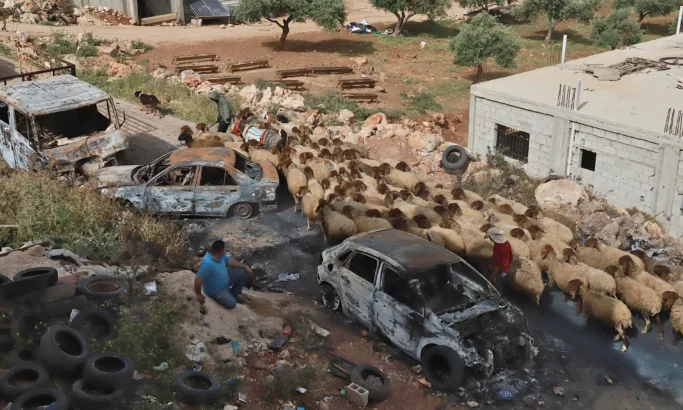
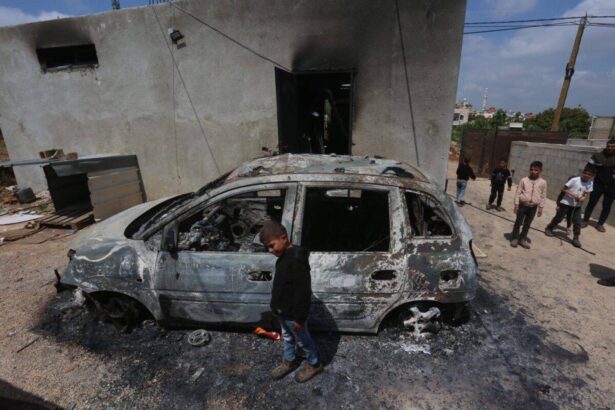
PA official: Israeli settlers set fire to car near Nablus

Ma'an
Israeli settlers set fire to a Palestinian car in the northern West Bank on Wednesday, a Palestinian Authority official said.....

The PA official demanded that the US put pressure on Israel "to stop the daily and repeated settler attacks."

......In February, settlers chopped down dozens of olive trees in the same village, Daghlas said at the time, while the Civil Administration said representatives were dispatched to the scene to investigate.

The month also saw settlers smash windshields of cars driving along the Nablus-Jenin road and assault a Palestinian doctor. "Attacks by settlers on Palestinians in the Nablus district continue, almost every day," Daghlas said.

Israel has vowed to "take severe measures against those involved" in disturbances in the area, after several dozen settlers attacked a military patrol near Yitzhar, injuring a soldier and two paramilitary police officers.

The attacks followed an incident in which a settler shot a Palestinian teenager in the same area during clashes that also left five Israelis injured. At the time, Israel's army also vowed to investigate the shooting.   Full story

Israeli authorities release Gaza businessman

Ma'an
Israeli authorities released a Gaza businessman on Wednesday, detained by Israeli forces at the Erez crossing one week earlier.

Ahmad Salim Abu Eida was detained on 4 March, and was interrogated by Israeli intelligence who failed to secure an indictment to continue his detention, security sources told Ma'an.

Palestinian Authority officials appealed to Israeli authorities to end what they termed an "Israeli intelligence campaign against Gaza businessmen aimed at crippling the business sector."


The campaign, they said, harmed the Palestinian economy, which has been stalled as a result of the ongoing Israeli imposed siege on the Gaza Strip...   Full story

PA: New settlements could derail talks

Ma'an
Israel's plan to build 1,600 new housing units in occupied East Jerusalem is "dangerous" and has the potential to thwart US efforts to restart peace talks, the Office of the President said Tuesday.

The Israeli Interior Ministry's announcement came one day after it approved 112 housing units in the Betar Illit settlement in Bethlehem.

Presidential spokesman Nabil Abu Rudeineh issued a stern response to the move, which came a day after US envoy George Mitchell arrived in the region, saying it could "derail negotiations and ensure the failure of US efforts before they begin."

Abu Rudeineh added: "It is now apparent that the Israeli government does not want negotiations, nor does it want peace. The American administration must respond to this provocation with effective measures."

He said moving forward would "no longer be tolerable" after "these provocations" absent action from the US. "Without real and effective American pressure, adopting a position that would make Israel stop these actions, they will destroy the peace process."

The White House also condemned the move, spokesman Robert Gibbs said hours after the announcement. US Vice President Joe Biden, in Israel since Monday, was expected to make a statement, as well.

The Israeli Interior Ministry defended the announcement's timing, insisting it was not deliberate.

"The Jerusalem District Planning Committee ... approved a plan which has been in the works for over three years. This is a procedural stage in the framework of a long process that will yet continue for some time," the ministry said in a statement.

A meeting that approved the construction "was determined in advance and there is no connection to US Vice President Joe Biden's visit to Israel. Interior Minister Eli Yishai updated Prime Minister Benjamin Netanyahu on the foregoing earlier this evening," it concluded.

Saeb Erekat, the chief PLO negotiator, expressed reservations on the recently announced indirect negotiations, long sought since US President Barack Obama took office.

"President [Mahmoud] Abbas wants certain answers to some inquiries he submitted to US Middle East envoy George Mitchell before indirect talks can start," Erekat told reporters in Jericho.

"The required answers are about the Israeli government's approval of more residential units in settlements and home demolitions. We expect answers within the coming days," he added.

Erekat said the proposed indirect negotiations, expected to begin in days, would be futile if the borders of the future Palestinian state were not agreed upon in advance. Border proposals must include all the Palestinian territories occupied on 4 June 1967, he added.

The top PLO official stressed that "indirect talks shouldn't be traditional, with the US mediator shuttling between two rooms designated for the negotiation teams ... We want a practical negotiations process, where each negotiating team can hold consultations.

"The process may involve two separate delegations, invited to Washington separately, to discuss each issue in order to bridge the gap and thus both sides start direct negotiations."

Erekat suggested that Mitchell affirm that the Palestinian state will include all the territories occupied on 4 June 1967, and that in the event territories were to be exchanged, it would be on an equal basis.

Furthermore, Netanyahu's government should demonstrate its commitment to negotiations by halting settlement activities, stopping the daily detentions of Palestinians, and freezing construction on the separation wall, he said.

"If these activities continue, Israel will be foiling the US proposal and international efforts," Erekat insisted.  Full story

Haniyeh to appoint female minister

Ma'an
De facto Prime Minister Ismail Haniyeh announced Tuesday that his government intends to appoint a female minister to head a Women’s Affairs Ministry in the Gaza Strip.

“The government is planning to appoint a number of female ministers to better include them in the decision-making process,” Haniyeh told attendees at an event honoring women in the workforce in Gaza City.

“We are a national government, based on Islamic principles, and we call on women to be more involved in the parliament, municipalities, and ministries. We are proud of this for this is a woman’s right,” he added, speaking at the Palestinian Legislative Council building.

Haniyeh said the Gaza government will place more importance on women’s issues, and giving their concerns more attention.

The announcement came a day after Palestinian women marked International Women's Day, taking part in rallies and other events throughout the occupied Palestinian territories.   Full story

Witnesses: Israeli official attempts J'lem home takeover

Ma'an
Israeli Deputy Mayor of Jerusalem David Harari attempted to forcibly enter the Sheikh Jarrah home of Rifqa Al-Kurd on Tuesday morning, but was halted by a number of Jerusalemites, Fatah's Jerusalem affairs chief Hatem Abdul Qader said.

Reports from residents say Harari was in the area on a solidarity visit with the settlers, and was exploring the possibility of taking over part of the Al-Kurd home for an office.

Settlers took over one third of the Al-Kurd home last August, setting off a string of home invasions. As of February, nine homes in the Sheikh Jarrah neighborhood were occupied by Israeli settlers...  Full story

Hamas detainees mark 18th year in Israeli custody

Ma'an
Three prisoners affiliated with Hamas marked 18 years in Israeli detention on Tuesday, the Detainees Support Committee said...  Full story

Peaceful protest in Israel can lead to arrest

New Haven Register - Mazin Qumsiyeh
THIS week, when I return to my village in the occupied West Bank, I face possible arrest by Israel for engaging in nonviolent protests against abusive Israeli policies opposed by our own government.

This prospect is difficult after 29 years of living in the United States, where such activities are fully protected. It was this openness that attracted me to the U.S. I became a proud citizen and pursued work not only in my profession but also as a human rights advocate.

Over the years, I gave hundreds of talks and participated in many vigils and protests, mostly against the war on Iraq and for justice and equality in Israel/Palestine. The activities always involved people of all backgrounds.

When I moved back to Palestine in early 2008, I continued to engage in these activities. I teach and have helped to establish a master’s program in biotechnology at Bethlehem University. I also pursue my passion of educating others on human rights and engaging in civil resistance through protests and vigils.

On March 1, shortly after I left my village near Bethlehem for a visit home to the United States, the Israeli army invaded the neighborhood and surrounded our house at 1:30 a.m. My mother, sister and wife, terrorized for no reason, told the military I was out of the country but would be “happy” to talk to them upon my return.

The soldiers delivered a note demanding my appearance in a military compound five days later — a date I have missed because my ticket was scheduled for a few days later. I thus face the likelihood of arrest, administrative detention or worse when I go back.


My story is just a minor manifestation of a disturbing pattern. As civil resistance against Israel’s West Bank apartheid wall and settlement activities have increased, there has been an escalation of Israeli repression of nonviolent protesters.

Nonviolent resistance to colonization and occupation are consistent with international law and U.S. policies. President Barack Obama has stated that settlement activities in the occupied territories must stop as a prelude to ending the occupation that started in 1967. Yet, Israeli authorities continue settlement activities apace, while intensifying attacks against peaceful vigils and protests against this indefensible behavior.

Obama also gave clear encouragement to nonviolent Palestinian demonstrators in his Cairo speech, yet has remained silent as nonviolent demonstrators have been seized in recent weeks by the Israeli military.

Bethlehem has suffered significantly because of Israeli actions. The district is squeezed now by illegal Israeli settlements and military installations on three sides. Bethlehem’s 130,00 residents have access to only 20 percent of the original land of the district. The settlers, protected by the Israeli military, now want to build a settlement in the only remaining open side of Bethlehem — to the east in an area called Ush Ghrab.

The people of my village, Beit Sahour, are known for a history of nonviolent resistance, including a tax revolt in 1988 against the Israeli military government. We are a town with limited resources, comprised of 70 percent Christians and 30 percent Muslims, but have a highly educated middle class with more than 300 holders of doctorates among the population of 12,000.

Having lost so much land, and being well-informed and connected to the outside world, we decided to nonviolently resist the additional Israeli encroachment on our town. The Israeli response relied on brute force. Our first prayer vigil was attacked while a Lutheran priest was leading us in prayer.

As a member of the committee that organized the vigil and another peaceful event a week later, I was targeted. An Israeli officer warned me not to participate and threatened me, noting he knew I was planning to come home to the U.S. for a lecture tour.

Given that the Israeli government receives billions in U.S. military aid, my taxes and yours at work, our government should defend those of us who engage in nonviolent protests. I was encouraged last week, therefore, in meeting with the office of U.S. Sen. John Kerry, chairman of the Senate Foreign Relations Committee, that his office will pursue my concerns with the State Department and the Israeli government.

While I fear for myself, I am more worried for other activists who do not have the minimal protection of a U.S. passport. And, I am terribly worried for our future as we are squeezed into smaller and smaller apartheid-like Bantustans.

We will not be deterred from nonviolent protest. Despite being let down by numerous governments, we look to the United States and elsewhere in the international community to help defend us from abusive and violent responses to nonviolence.  Full story

Mazin Qumsiyeh was an associate professor of genetics at Yale University School of Medicine and lived in Orange before moving to Palestine. Write to him at Bethlehem University, 9 Freres St., Bethlehem, Palestine. E-mail: mazin@qumsiyeh.org.

Tuesday, March 9, 2010

Daily Situation Report: March 7, 2010

PMG
Israelis on Palestinian land:
  • Caused Injuries — 3 
  • Physical Assaults — 2 Severely beat a woman and her son
  • Arrests (per person) — 8 Incl. 3 in Qalqiliya & 2 in Hebron
  • Detentions — 15 Incl. 3 university students
  • Raids – 29 Incl. 1 in Raml’h. & 1 in Northern Gaza
  • Checkpoints — 10 Access impeded at 7 checkpoints
  • Flying Checkpoints — 17 Incl. 3 in Jenin & 1 in Tulkarm
  • Attacks – 4, 3 in confrontations & 1 in a raid
  • Air Patrols – 2 Incl. reconnaissance above N. Gaza dis.
  • Provocation of Pal. Forces — 1 Incl. detention of civil police vehicle
  • School Obstruction — 1 Besieging Al Quds Open University
  • Land Leveling — 1 Area of land in Northern Gaza district
  • Wall Construction — 22 Jer., Raml’h., Qalq., Salfit, Heb., Beth.
  • Closure (per District) — 7 Jer., Beth. (2 villages) & Hebron (4 areas)
  • Closure of Crossing Points —  5 Only 2 crossings are open
  • Closure of Main Roads — 40 Incl. 2 in Tulkarm & 1 in Jenin
  • Settler Violence — 1 Stoning civilian vehicles in Qalqiliya dis.
Palestinians on Palestinian land:
  • Demonstrations — 2 Incl. against causing the death of 6 people  Full report 

Banks urge Americans to close Israeli accounts

Ha'aretz
Obedient to intensifying U.S. government pressure to crack down on offshore tax evaders, in January Israeli banks began ordering clients they identify as "Americans" or "U.S. tax residents" to close investment accounts they hold in Israel.....

.....Finance professionals estimate that U.S. residents hold several billion dollars in Israeli investment accounts.   Full story

3,000 Arab graduates looked for jobs: Only 170 found one

Ha'aretz
Israel's keenness to join the Organization for Economic Cooperation and Development presents a golden opportunity for minorities to narrow the economic gap with the Jewish population.

The OECD has stated it won't let Israel join its ranks before this problem is solved, and Israel's highest-ranking officials immediately mobilized: Prime Minister Benjamin Netanyahu formed four committees devoted to narrowing the gaps, and President Shimon Peres sent a busload of business leaders to give them a glance - for some it was their first - at the job market for Arab college graduates.....

? In 2005 there were 57,800 Arabs with college degrees in Israel, or 8.7% of the Arab population of employment age (18-65), compared to 20% of Jews.

? Of these Arab with degrees, 77% (44,500 in total) were employed, but only half of them in jobs that utilized their education.

? 3.6% were unemployed, and 19.8% weren't in the work force (meaning, they were not looking for jobs or seeking unemployment benefits).

? For the sake of comparison, in the Jewish population 83.4% of college graduates were working, 3.6% were unemployed and 12.9% were not in the work force.

? 24% of Arabs with degrees said they had despaired of finding work that met their skills, as compared to 3% of Jews.

? The salary of an Arab college graduate was (and remains) 35% lower than that of a Jewish graduate.

Another statistic? Every year 11,000 Arabs complete a degree program, but only 20% of them study professions that are in demand in the job market. And still, every year more than 2,000 graduates seek jobs in Israel. And they find it's tough going.

.......In the organization's two years, 170 Arabs were found jobs that utilized their training, at Jewish-owned firms. However, this is only a small percentage of the 3,000 people whose resumes the organization sent to employers.

Only 500 candidates were invited to interviews...

........One of the major barriers for Arabs are the hiring exams, most of which are cognitive and based on language and culture. The interview is also based on the candidate's ability to sell himself - something that contradicts Arab culture, which is more collective than individualistic.

"When the exams and interviews do not take cultural differences into account, the Arab academics simply fail, and that's not justified," says Tamir.

...cites A., who has a master's in law from Bar-Ilan University. A. applied to be an attorney at one of the banks. A. failed the regular assessment exams, but after a conversation with the human resources director at the bank, A. was sent to another testing center. Those tests lasted a full day, and analyzed candidates' abilities - and A. did fantastically. Since then he has been working at the bank, and everyone is satisfied.

And there is the problem of the internal glass ceiling. Even when an Arab is hired for a job in high-tech, he is subject to discrimination against in terms of salary and conditions. Y. was hired to work as a high-tech engineer, and discovered he was earning about half what his colleagues were making - and he didn't get a company car, either. His attempts to improve his terms hit a wall, so he decided to resign and to switch to another firm. After reaching understandings with the second firm about his employment terms, he informed his employer he was leaving. Then the fight over him began - because he was an outstanding worker. He eventually wound up staying at his current job, but gained a company car and a much higher salary.

A year and a half ago, Lautman performed an experiment: He sent the resumes of 14 graduates of the same university departments to industrial and service companies in the center of the country. Only seven graduates received replies. All of them were Jewish. The Arab graduates with the same educational background went unanswered.....  Full story

Palestinians rally against Gaza buffer zone

Ma'an
Hundreds of Palestinians and international solidarity activists joined the weekly challenge to the enforced no-go zone in the northern Gaza Strip on Tuesday, walking out toward the border wall, which has a 150-700meter 'buffer' patrolled by the Israeli military.

The rally, organized by the popular campaign against the separation fence in Gaza, gathered at the Agricultural College and walked together toward the Erez crossing. Participants chanted slogans opposing the buffer zone, which eats into 15% of the available agricultural land in Gaza, according to the UN Office for the Coordination of Humanitarian Affairs...   Full story

Israeli Defense Ministry goes on trial for Corrie death

Ma'an
On Wednesday, the Israeli Defense Ministry will go on trial as a court hears a case filed by the parents of an American woman run down by an Israeli military bulldozer in Gaza, in March 2003.

A civil suit seeks to hold Israeli forces responsible for the death of Rachel Corrie, a 23-year-old activist who was crushed to death as she protested a Palestinian home from demolition in the Gaza Strip.

"We claim that her assassination was intentional," or, at the very least, that the army is guilty of "huge negligence," Hussein Abu Hussein, the attorney who filed the petition on behalf of Corrie's parents, commented.

Abu Hussein cites the state's acknowledgment of the fact that Corrie and other members of the International Solidarity Movement—a Palestinian-led peace organization that advocates non-violent means of resistance to the Israeli occupation—were demonstrating in the area for several hours before Corrie was struck by the bulldozer. He also points out that Corrie was wearing a fluorescent orange vest to increase her visibility.

At the time of her death, the Israeli military response was that the driver of the machine did not see Corrie.

"If you see people, you should stop and think of all the needed steps not to harm [them]. Instead of stopping the D9, which weighs 64 tons, they continued. And due to that, [Corrie] was killed,"...

Four of Corrie's fellow activists who witnessed her death were initially denied entry into Israel where they were asked to testify at the trial, but US pressure reportedly changed the Israeli position. A US citizen and three UK nationals will now be able to speak at the trial, which is expected to last two weeks.

Israel will not issue an entry permit to Dr Ahmed Abu Nakira, the Gazan physician who saw Corrie after she was injured and declared her dead. The state rejected the request for his entry on the grounds that there is no coordination between Israel and Gaza, due to the Israeli blockade that began after Hamas rose to power in 2007.

"It's an obstacle to justice," Abu Hussein said. "On the one side, [Israel] won't give permission [for Dr Abu Nakira] to come; on the other they won't allow him to testify by videoconference, which is used daily by courts everywhere in the modern world."

Speaking shortly after Corrie's death, an Israeli military representative called the incident a "regrettable accident." An internal investigation conducted by the Israeli army later absolved the soldier operating the bulldozer of any wrongdoing.

The report, released in April 2003, claimed that Corrie was not killed by the "engineering vehicle" but "was struck by a hard object, most probably a slab of concrete which was moved or slid down while the mound of earth which she was standing behind was moved." The army accused Corrie and the other activists present of behaving in an "illegal, irresponsible, and dangerous" manner.

Abu Hussein says that the army's investigation lacked transparency. The civil suit, which was filed in 2005, is the only way to hold the state accountable for Corrie's death, he says.

While it is exceedingly rare for the Defense Ministry to take direct responsibility in such cases, the state has made financial reparations to a handful of families like the Corries. Just two months after Rachel's death, British journalist and filmmaker James Miller, 34, was shot to death by an Israeli soldier. After an army investigation found no wrongdoing, the UK warned it would extradite the soldiers involved. Last year, Israel settled out of court with Miller's family for approximately 1.5 million pounds (2.25 million US dollars).

"The family is not seeking money. They're seeking acknowledgment of responsibility by the state," Abu Hussein says. If the Corries do receive compensation from Israel, they intend to donate the sum to "the matter Rachel was struggling for—for peace."

The Corries' suit "underscores that Israel doesn't prosecute" soldiers accused of wrongdoing and that the state behaves it is "exempt from accountability," Abu Hussein said.

"In the cases brought by Palestinians against the IDF [Israeli forces], more than 90 percent are denied," he says, pointing to a culture of immunity that has been criticized human rights groups.

From 2000 to 2009, the Israeli NGO Yesh Din monitored almost 2000 Israeli military investigations into incidents in which a Palestinian or international claimed the army was guilty of a criminal offense, including unlawful shooting that led to injury or death. Indictments were filed in only six percent of these cases. Many of the soldiers who were prosecuted cut deals with the court that reduced the severity of both the charges and punishments.

"When we look at the number of cases, and we look at the fact that only six percent yield indictments, it is safe to assume that a soldier in the field today will know that he can get away with pretty much anything," Yesh Din's research director Lior Yavne remarked.

A representative for the Corries emphasized that the family hopes the upcoming trial will bring attention to ongoing human rights abuses perpetrated by the Israeli army in the occupied Palestinian territories. "The issue is Palestine and human rights defenders," the liaison says. "They want to highlight Gaza in light of [the UN-commissioned] Goldstone [report] and Operation Cast Lead."  Full story

Israeli forces detain 3 teenagers near Bethlehem

Ma'an
Israeli forces detained three teenagers early Tuesday morning from the village of Husan, west of Bethlehem.

Eyewitnesses said the forces raided the village and detained Muntaser Muhammad Za’loul, 17, Hamza Abdullah Shosha, 19, and Laith Shosha, 19... Full story

Israeli forces detain 2 children in Hebron

Ma'an
Israeli forces detained two children near the Yashai settlement in central Hebron on Monday, after a scuffle that left an Israeli child lightly injured.

The two, identified as Ibrahim Abu Ayasha, 11, and Sharif Abu Ayasha, 12, were reportedly on their way home in the Tel Ar-Ramedia area.

An unidentified child of one of the Israeli settlers in the area stood in the way of the children, witnesses said, and broke a bird cage that one of them was carrying. An ensuing scuffle led to the Israeli child being injured.

An Israeli military spokeswoman said soldiers offered initial medical assistance to the Israeli child, whose injuries were described as light.

Israeli forces detained the two Palestinian children, the spokeswoman confirmed, adding that they were being held by Israeli police in Hebron in connection with the incident. Police were questioning both sides, she said.

Three Palestinian children were detained by Israeli soldiers a day earlier as they gathered herbs in At-Tuwani village, southern Hebron, a peace organization reported. The three were released 15 minutes later.

Meanwhile, Hassan Al-Muhtaseb, 12, was released from custody when an Israeli military court in Ofer prison ordered his father to pay a 2,000-shekel fine. Hassan was detained last Monday with his brother Al-Amir, 9, who was later released.  Full story

Congressional Junket Front-Page News Unless It’s a Trip to Israel

Washington Report on Middle East Affairs

The ongoing controversy regarding Representative Charles Rangel (D, NY-15) and trips to the Caribbean in 2007 and 2008 has refreshed the discourse on privately funded congressional travel. Following the Jack Abramoff scandal of 2006 stricter limits were adopted by the House in order to expose and prevent corporate-sponsored junkets. The new ethics rules stipulated that members could not accept trip funding from non-profits that had received corporate donations, which would constitute lobbying.

Rep. Rangel was investigated for having violated these rules by attending conferences in St. Maarten sponsored by the Carib News Foundation. Major corporations, including Citigroup and Pfizer, however, appear to have earmarked donations to Carib News specifically for the trips. Rep. Rangel’s staff was apparently aware of the connection between the corporations and Carib News, whereas Rep. Rangel maintains that he was never informed of such a link. Therein lies the debate: Is Rep. Rangel to be held accountable for the improper conduct of his staff?

The case, moreover, exposes the inconsistencies of the ethics rules constraining congressional behavior. The rules intend to restrict the influence of lobbyists; however, they do nothing to constrain so-called “educational” organizations. Under the current rules, a non-profit like the American Israel Education Foundation (AIEF) is considered an independent entity from its parent group the American Israel Public Affairs Committee (AIPAC), which self-identifies as “America’s Pro-Israel Lobby.”

Under this arrangement we are to assume that AIPAC’s hard-line, rightist views of the Arab-Israeli conflict have not once influenced the “education” imparted on the 480 trips (at a cost of $4,024,845) sponsored by AIEF since Jan. 2000. Unfortunately, the link between AIEF’s “educational” efforts and AIPAC’s lobbying are as obvious as they appear. Members and staffers participating in the trips are bombarded by a one-sided distortion of reality. The perspectives generated by these “educational” sojourns rarely include moderate or left-leaning voices in Israel. When, if ever, was B’Tselem or Peace Now involved in the “education” process? Furthermore, the trips neglect the Palestinian perspective altogether.

A spade will always be a spade and a lobby will always be a lobby, whether or not it markets itself as an “educational” organization. Clearly, the ethics rules in place do not do enough to prevent the undue influence of lobbies on the legislative process.

For further information regarding trips sponsored by AIEF and similar groups please consult the following table:

Rank Top Ten Members in Terms of Approved Trips Sponsored by Pro-Israel Groups Pro-Israel Groups Funded Travel* # of Trips Sponsored by Pro-Israel Groups*
1 Hoyer, Steny H (D, Maryland District 5 ) $142,426.02 17
2 Berkley, Shelley (D, Nevada District 1 ) $102,910.67 14
3 Blunt, Roy (R, Missouri District 7 ) $69,356.98 10
4 Kirk, Mark (R, Illinois District 10 ) $64,503.09 9
5 Green, Gene (D, Texas District 29 ) $50,527.94 4
6 Wexler, Robert (D, Florida District 19 ) $46,171.94 5
7 Pence, Mike (R, Indiana District 6 ) $45,288.05 5
8 Gohmert, Louis B Jr (R, Texas District 1 ) $44,753.60 3
9 Bachmann, Michele (R, Minnesota District 6 ) $44,381.14 3
10 Langevin, Jim (D, Rhode Island District 2 ) $43,302.15 7

--------------------------
------------------------------------------------------
Member Pro-Israel Groups Funded Travel* # of Trips Sponsored by Pro-Israel Groups*
* - Trips are those approved, which includes all trips from office both by members and by staffers...

Is Europe planning seal of approval for Israeli settlers?

Ma'an
An exclusive club of the world's most developed countries is poised to admit Israel as a member even though, a confidential internal document indicates, doing so will amount to endorsing Israel's illegal occupation of Palestinian and Syrian territories.

Israel has been told that its accession to the Organisation for Economic Cooperation and Development (OECD) is all but assured when the 30 member states meet in May.

But a draft OECD report concedes that Israel has breached one of the organization's key requirements on providing accurate and transparent data on its economic activity.

The information supplied by Israel, the report notes, includes not only the economic activity of its citizens inside its recognised borders but also Jewish settlers who live in the occupied territories of East Jerusalem, the West Bank and the Golan in violation of international law.

Israel's accession to the OECD on such terms threatens to severely embarrass many of the organization's member states, especially those in the European Union that are publicly committed to avoiding collusion with the occupation.

The OECD report proposes that these legal difficulties may be circumvented by asking Israel to produce new statistics within a year of its accession excluding the settler population "even though, an OECD official has admitted, Israel would have the power to veto such a demand after it becomes a member.

"The OECD seems to be so determined to get Israel through its door that it is prepared to cover up the crimes of the occupation," said Shir Hever, a Jerusalem-based economist.

Israel has been lobbying for nearly 20 years to be admitted to the OECD, founded in 1961 for wealthy industrialised democracies to meet and co-ordinate economic and social policies. It includes the United States and most of Europe.

"The financial privileges are relatively modest, but there is great prestige to being accepted ... Israel has worked so hard to gain admission because it believes accession will confer international legitimacy on its occupation," Hever said.....

Israel's past rejections, it is widely assumed, were because many states were uncomfortable about admitting Israel while it was occupying the Palestinian territories of East Jerusalem, Gaza and the West Bank and the Syrian-owned Golan Heights.

However, Israel was formally invited to begin discussions about membership in 2007 after intense lobbying by Stanley Fischer, the governor of the Bank of Israel. Membership is expected to bring financial stability to Israel's economy, attract investment and reduce the country's risk premium.

The OECD's secretary general, Angel Gurria, visited in January, after a review of Israel's economy, and suggested that admission this year was a certainty.

However, a leaked draft report by the OECD's committee on statistics, produced last month after the review, shows there are major problems with the data presented by Israel.

According to its rules, the OECD takes account of economic activity outside a candidate state's recognised borders in very limited circumstances, such as with remittances from migrant workers.

But given that this status does not apply to the illegal settlers living in the occupied territories, the OECD committee argues that either the settlers be excluded from the data or everyone living in the territories - including Palestinians - should be factored in.

"Israel has been caught out because it has always refused, even in its own internal data, to differentiate between Israel and the occupied territories," Hever said. Both East Jerusalem and the Golan have been annexed by Israel in violation of international law.

"The OECD is treating Israel as though it has seven million citizens when, in reality, it has 11 million subjects, of whom four million are Palestinians living under occupation ... If they were included in the figures submitted to the OECD, Israel would have to be refused accession because of the enormous disparities in wealth," Hever added.

Meron Benvenisti, a former deputy mayor of Jerusalem, noted recently that there was a 20:1 ratio in the difference in gross domestic product per capita between an Israeli and a Palestinian living in Gaza.

But rather than conclude that Israel has failed to meet the organization's entry criteria, the committee proposes a workaround: Israel can be accepted to the organisation and given a year to submit new data excluding the settlers.

Tim Davis, an OECD official with the statistics committee in Paris, said he could not comment on the report because its contents were confidential but agreed that there was nothing to stop Israel reneging on such a commitment in the future. "In a case like that, nothing could be done in practice. We work on the basis of co-operation, not pressure."

Israel is reported to have failed other entry conditions, including on corruption and copyright violations.

The OECD has required member states to crack down on corrupt practices since it approved a convention against bribery in 1997. Israel, however, was ranked in 32nd place in a major index on corruption last year, with much of it relating to the country's 6 billion US dollar arms industry.

European and US defence firms have threatened to derail Israel's OECD bid if it does not clean up its act.

Israel is also believed to be violating intellectual property rights, again in breach of OECD rules. US and Swiss firms have accused Israel of failing to regulate the international marketing of drugs produced by its largest pharmaceuticals company, Teva.

Israel's bid for OECD membership has been opposed by the leaders of its Palestinian minority, one-fifth of the population. Last month the Higher Follow-Up Committee, the minority's main political body, petitioned the OECD to reject Israel.

It has pointed out that half of Israel's Palestinian citizens are living below the poverty line, a rate three times higher than among Israeli Jews, and that on average Palestinian citizens earn salaries that are one-third less than Jews. Mohammed Zeidan, head of the committee, blamed the disparities in wealth on what he called Israel's "racist and discriminatory polices."

Another OECD report, published in January, showed that, even on the basis of Israel's figures excluding the Palestinians, Israel would still have the widest social gaps of any member state if it were accepted.  Full story

Quiet revolution that is freezing Palestinians out of Jerusalem

UKGuardian - Rory McCarthy
In the brochure handed out by the mayor's office in Jerusalem last week, there were pretty sketches illustrating a development that would turn a poor, crowded area into a park, with streams, restaurants and hotels. It talked of reviving the area's "ancient glory" and returning the site to "an island of green" just outside the walls of the Old City. True, some houses would have to be demolished but they had been built illegally and anyway the plan was a "win-win" for both the residents and the city, said the mayor, Nir Barkat.

Except that Jerusalem is not any city: it is at the heart of the conflict between Israel and the Palestinians and planning projects like this are political and potentially volatile. The area under the spotlight is Bustan, part of Silwan in east Jerusalem, home to Palestinians and, increasingly, to well-funded, heavily guarded Jewish settlers. Most of the world, including Britain, does not recognise Israeli sovereignty in the east of the city, the part it captured in 1967, occupied and then annexed.

Barkat is a secular mayor with strong rightwing views. When asked about the Palestinians of Bustan, he intervened to say they were "Arab residents". He highlighted the fact that the 88 Palestinian homes in Bustan were built without planning permission and that a city like New York, say, would never allow unplanned homes to be built in Central Park. But planning here is an instrument of policy, a policy in which Israel maintains a Jewish demographic majority in Jerusalem and seeks to exert full control over the city it regards as its united, eternal capital. Few Palestinians get planning permission, but most go ahead and build regardless. Only 13% of the east is zoned for Palestinian construction, according to the UN.

Although much attention has been paid to rows over settlements in the occupied West Bank, it is in Jerusalem that the key contest is being fought. The rightwng government insists a united, fully sovereign Jerusalem is a pillar of the Jewish state. But Palestinians say without east Jerusalem as a capital of a Palestinian state there can be no viable two-state peace agreement.

The Bustan plan – on hold now because Israel is conscious of international criticism – is one change among many. In Sheikh Jarrah, also in the east, Palestinian refugees have been evicted from their homes and settlers have moved in. A growing number of Palestinians are losing Israeli residency permits without which they cannot live in the city. New passport stamps issued by Israel at the Jordanian border are preventing some visitors – mostly expatriate Palestinians – from entering Jerusalem. Put together, it represents a significant, if quiet, change on the ground. European diplomats are so worried that in leaked internal reports they warn it is gradually making the prospect of a two-state peace deal "unfeasible"Full story

Mullen Wary of Israeli Attack on Iran

Consortium News - Ray McGovern
Adm. Mike Mullen, Chairman of the Joint Chiefs of Staff, came home with sweaty palms from his mid-February visit to Israel. Ever since, he has been worrying aloud that Israel might mousetrap the U.S. into war with Iran.

This is especially worrying, because Mullen has had considerable experience in putting the brakes on such Israeli plans in the past. This time, he appears convinced that the Israeli leaders did not take his earlier warnings seriously — notwithstanding the unusually strong language he put into play.

Upon arrival in Jerusalem on Feb. 14, Mullen wasted no time in making clear why he had come. He insisted publicly that an attack on Iran would be “a big, big, big problem for all of us, and I worry a great deal about the unintended consequences.”

After his return, at a Pentagon press conference on Feb. 22, Mullen drove home the same point — with some of the same language. After reciting the usual boilerplate about Iran being “on the path to achieve nuclear weaponization” and about its “desire to dominate its neighbors,” he included this in his prepared remarks:

“I worry a lot about the unintended consequences of any sort of military action. For now, the diplomatic and the economic levers of international power are and ought to be the levers first pulled. Indeed, I would hope they are always and consistently pulled. No strike, however effective, will be, in and of itself, decisive.”

In answer to a question about the “efficacy” of military strikes on Iran’s nuclear program, Mullen said such strikes “would delay it for one to three years.” Underscoring the point, he added that this is what he meant “about a military strike not being decisive.”

Unlike younger generals, such as David Petraeus and Stanley McChrystal, Adm. Mullen served in the Vietnam War. It seems likely that this experience prompted his philosophical aside about the war in Afghanistan:

“I would remind everyone of an essential truth: War is bloody and uneven. It’s messy and ugly and incredibly wasteful, but that doesn’t mean it isn’t worth the cost.”

Though the immediate context for that remark was Afghanistan, Mullen has underscored time and again that war with Iran would be a far larger disaster. Those with a modicum of familiarity with the military, strategic and economic equities at stake know he is right.

Firing ‘Fox’

Recall that one of Mullen’s Vietnam veteran contemporaries, Adm. William “Fox” Fallon was cashiered as CENTCOM commander in March 2008 for saying things like war with Iran "isn't going to happen on my watch.”

Fallon openly encouraged negotiations with Iran as the only sensible approach, and harshly criticized the “constant drum beat” for war.

Fallon’s attitude appears to be shared by the more politically cautious – and less rhetorically blunt – Mullen, as the same war-with-Iran drumbeat reaches a new crescendo today.

Fallon abhorred the thought of being on the receiving end of an order inspired by the likes of then-Vice President Dick Cheney and Deputy National Security Adviser Elliott Abrams to send American troops into what would surely be – in Mullen’s words – a “bloody, uneven, messy, ugly and incredibly wasteful” war.

How strong the pressure was within the Bush administration to attack Iran – or to give Israel “a green light” to attack Iran – can be read between the lines in a Feb. 14 exchange between ABC News’ “This Week” host Jonathan Karl and former Vice President Cheney.

Karl: “How close did the Bush administration come to taking military action against Iran?” 

Cheney: “Some of that I can't talk about, obviously, still. I'm sure it's still classified. We clearly never made the decision – we never crossed over that line of saying, ‘Now we're going to mount a military operation to deal with the problem.’ …"

Karl: “David Sanger of the New York Times says that the Israelis came to you – came to the administration in the final months and asked for certain things, bunker-buster bombs, air-to-air refueling capability, over-flight rights, and that basically the administration dithered, did not give the Israelis a response. Was that a mistake?”

Cheney: “I can't get into it still. I'm sure a lot of those discussions are still very sensitive.”

Karl: “Let me ask you: Did you advocate a harder line, including in the military area, in those final months?” 

Cheney: “Usually.” 

Karl: “And with respect to Iran?”

Cheney: “Well, I made public statements to the effect that I felt very strongly that we had to have the military option, that it had to be on the table, that it had to be a meaningful option, and that we might well have to resort to military force in order to deal with the threat that Iran represented. … [But] we never got to the point where the President had to make a decision one way or the other.”

Renewed Pressures

Clearly, those pressures have not disappeared during the first 13 months of the Obama administration. Today, it appears that Mullen has replaced Fallon as the principal military obstacle to exercising the war option against Iran.

From his recent demeanor, as well as his many statements since he became the country’s most senior officer, it is apparent that Mullen does not believe that a “preventive war” against Iran would be worth the horrendous cost.

Washington rhetoric, echoed by the many stenographers of the Fawning Corporate Media over the past eight years, has brought a veneer of respectability to the international crime of aggressive war, as long as done or sanctioned by the United States.

With nodding approval from the FCM, Bush and Cheney sold the notion that such attacks can be justified to “prevent” some future hypothetical threat to the United States or its allies, the supposed rationale for invading Iraq in 2003.

Clearly, the Obama administration has not fully backed away from such thinking.
While in Qatar on Feb. 14, Secretary of State Hillary Clinton expressed concern over what she called “accumulating evidence” of an Iranian attempt to pursue a nuclear weapon, not because it “directly threaten[s] the United States, but [because] it directly threatens a lot of our friends” — read Israel.
Mullen, for his part, seems acutely aware that the Constitution he has sworn to defend makes no provision for the kind of war he might be sucked into to defend Israel. When he studied at the Naval Academy, his professors apparently were still teaching that the Constitution’s Supremacy Clause (Article VI, Clause 2) establishes that treaties ratified by the Senate become the “supreme law of the land.”
It would be, pure and simple, a flagrant violation of a supreme law of the land, the Senate-ratified United Nations Charter, for the United States to join in an unprovoked assault on Iran without the approval of the U.N. Security Council, which surely would not go along.
Adm. Mullen also appears to be one of the few Americans aware that there is no mutual defense treaty between the United States and Israel and, thus, the U.S. has no legal obligation to jump to Israel’s defense if it ignites war with Iran.
Now you may scoff. “Everyone knows,” you will say, that political realities in America dictate that the U.S. military must defend Israel no matter who started a conflict.
Still, there was a time – after the 1967 Israeli-Arab war when Israel first occupied the Palestinian territories – that the U.S. did take soundings regarding the possibility of a mutual defense treaty, in the expectation that this might introduce more calm into the area by giving the Israelis a greater sense of security.
But the Israelis turned the overture down cold. Such treaties, you see, require internationally recognized boundaries and Israel did not want any part of parting with the territories it had just seized militarily.
Besides, mutual defense treaties usually impose on both parties an obligation to inform the other if one decides to attack a third country. Israel wanted no part of that either.
This virtually unknown background helps to explain why the lack of a treaty of mutual defense is more than a picayune academic point.
Why Is Mullen Worried?
Yet, if Adm. Mullen is an old hand at reining in the Israelis, why is he so visibly worried at present? He’s had experience in reading the riot act to the Israelis. So what could be so different now?
Last time, in mid-2008, Cheney and Abrams were arguing for an aggressive military posture toward Iran but lost the argument to Mullen and his senior commanders, who – in the final days of the Bush administration – won the backing of President Bush.
When former Prime Minister Ehud Olmert seemed intent on starting hostilities with Iran before Bush and Cheney left office, Bush ordered Adm. Mullen to Israel to tell the Israelis, in no uncertain terms, don’t do it. Mullen gladly rose to the occasion; actually, he outdid himself.
With Bush’s full support, Mullen told the Israelis to disabuse themselves of the notion that U.S. military support would be knee-jerk automatic if Israel somehow provoked open hostilities with Iran.
We also learned from the Israeli press that Mullen went so far as to warn the Israelis not to even think about another incident at sea like the Israeli attack on the USS Liberty on June 8, 1967, which left 34 American crew killed and more than 170 wounded.
Never before had a senior U.S. official braced Israel so blatantly about the Liberty incident, which was covered up unconscionably by Lyndon B. Johnson’s administration, the Congress, and by the Navy itself. ... [More info on Liberty incident]
The lesson the Israelis took away from the Liberty incident was that they could get away with murder, literally, and walk free because of political realities in the United States. Never again, said Mullen. He could not have raised a more neuralgic issue.
So, again, what’s different about today? How to account for Mullen’s decision to keep expressing his worries about “unintended consequences”?

I believe the admiral fears that things are about to spin out of control. Whether there will be war does not depend on Mullen — or even Obama. It depends on Israeli Prime Minister Benjamin Netanyahu. And Mullen does well to be worried.
Netanyahu’s Impression of Obama
It is altogether likely that Netanyahu has concluded that Barack Obama is — in the vernacular — a wuss. Why, for example, does the President keep sending an endless procession of the most senior U.S. officials to Tel Aviv to plead with their Israeli counterparts: Please, pretty please, don’t start a war with Iran.
Loose-cannon Vice President Joe Biden arrives on Monday, hopefully with clearer instructions than when he blithely told ABC on July 4, 2009, that Israel is a “sovereign nation” and thus “entitled” to launch a military strike against Iran, adding that Washington would make no effort to dissuade the Israeli government.
Will Biden manage to keep his foot out of his mouth this time, or will his nearly four decades of experience in the U.S. Senate – learning how to position himself politically in regards to Israel – again reassert itself?

It is a safe bet that Netanyahu is wryly amused at such obsequious buffoonery. But his impression of Obama’s backbone – or lack thereof – is key.
The Israeli Prime Minister must be drawing some lessons from Obama’s aversion to leveraging the $3 billion a year the U.S. gives to Israel. Why doesn’t he simply pick up the phone and warn me himself, Netanyahu might be asking himself.
Is Obama so deathly afraid of the powerful Likud Lobby that he cannot bring himself to call me? Is the President afraid his chief of staff, Rahm Emanuel, might listen in and leak it to neoconservative pundits like the Washington Post’s Dana Milbank?
Netanyahu has had ample time to size up the President. Their initial encounter in May 2009 reminded me very much of the disastrous meeting in Vienna between another young American president and Nikita Khrushchev in early June 1961.
The Soviets took the measure of President John Kennedy, and a result was the Cuban missile crisis which brought the world as close as it has ever come, before or since, to nuclear destruction.
The Israeli Prime Minister has found it possible to thumb his nose at Obama’s repeated pleas for a halt in illegal construction of Israeli settlements in the occupied territories — without consequence.

Moreover, Netanyahu has watched Obama cave in time after time — on domestic, as well as international issues.
Netanyahu styles himself as sitting in the catbird’s seat of the relationship, largely because of the Likud Lobby’s unparalleled influence with U.S. lawmakers and opinion makers — not to mention the entrée the Israelis enjoy to the chief executive himself by having one of their staunchest allies, Rahm Emanuel, in position as White House chief of staff. In the intelligence business, we might call that an “agent of influence.”
Emanuel’s father, Benjamin Emanuel, was born in Jerusalem and served in the Irgun, the pre-independence Zionist guerrilla organization. During the 1991 Persian Gulf War, Rahm Emanuel, then in his early 30s, traveled to Israel as a civilian volunteer to work with the Israeli Defense Forces. He served in one of the IDF’s northern bases.
Mullen’s Worries
So, Netanyahu is supremely confident of the solidity of his position with the movers and shakers in Congress, Washington opinion makers, and even within the Obama administration, and he gives off signs of being singularly underwhelmed by the President.
These factors enhance the possibility Netanyahu will opt for the kind of provocation that would confront Obama with a Hobson’s choice of either joining an Israeli attack on Iran or facing dire political consequences at home.
And so Mullen continues to worry — not only about “unintended consequences,” but about what might be accurately described as intended consequences, as well. The most immediate of these could involve mouse-trapping Obama into committing U.S. forces to war provoked with Iran.
And for those fond of saying that “everything is on the table,” be advised that this would go in spades in this context.
Very little seems outlandish these days. Remember Seymour Hersh’s report about Cheney’s office conjuring up plots as to how best to trigger a war with Iran? Hersh said:
“The one that interested me [Hersh] the most was why don’t we build — we in our shipyard — build four or five boats that look like Iranian PT boats. Put Navy Seals on them with a lot of arms. And next time one of our boats goes to the Straits of Hormuz, start a shoot-up.”
In other words, another Tonkin Gulf incident, like the one that President Johnson used to justify a massive escalation in Vietnam.
Only a modern-day Gulf of Tonkin in the Strait of Hormuz could be even more problematic, given the waterway's vital role as a supply route for oil tankers necessary for maintaining the world’s economy.
The navigable part of the Strait of Hormuz is narrow, and things often go bump in the night without trying. For example:
DUBAI, United Arab Emirates (AP) – On the evening of Jan. 8, 2007, a U.S. nuclear-powered submarine collided with a Japanese oil tanker in the Strait of Hormuz, through which 40 percent of the world's oil supplies travel, officials said. The collision between the USS Newport News and the Japanese-flagged motor vessel Mogamigawa occurred at approximately 10:15 in the evening (local time) in the Strait of Hormuz while the submarine was transiting submerged.
AP, March 20, 2009: “The USS Hartford nuclear submarine and the amphibious USS New Orleans collided in the waters between Iran and the Arabian peninsula today. Fifteen sailors were slightly injured aboard the Hartford…the New Orleans suffered a ruptured fuel tank, spilling 25,000 gallons of diesel….The ships were on routine security patrols in a busy shipping route.”
Think back also to the bizarre accounts of the incident involving swarming Iranian boats and U.S. naval ships in the Strait of Hormuz on Jan. 6, 2008.
Preventing Preventive War
The Persian Gulf would be an ideal locale for Israel to mount a provocation eliciting Iranian retaliation that could, in turn, lead to a full-scale Israeli attack on Iran’s nuclear-related sites.
Painfully aware of that possible scenario, Adm. Mullen noted at a July 2, 2008, press conference, that military-to-military dialogue could “add to a better understanding” between the U.S. and Iran.
If Mullen’s worries are to be taken as genuine (and I believe they are), it would behoove him to resurrect that idea and formally propose such dialogue to the Iranians.
He is the U.S. government’s senior military officer and should not let himself be stymied by neoconservative partisans more interested in regime change in Tehran than in working out a modus vivendi and reduction of tension.
The following two modest proposals could go a long way toward avoiding an armed confrontation with Iran — whether accidental, or provoked by those who may actually wish to precipitate hostilities and involve the U.S....  Full story

Ray McGovern: A 27-year veteran analyst at the CIA, is co-founder of Veteran Intelligence Professionals for Sanity (VIPS).

Saturday, March 6, 2010

Twilight zone / Unanswered questions

Ha'aretz - Gideon Levy
Musa Abu Hashhash could not hold back his tears. We have worked with this devoted field worker from B'Tselem, the Israeli Information Center for Human Rights in the Occupied Territories, for years. Never before had we seen him cry. But this week he broke down and wept after a visit to the widow of Fayez Faraj, his aged, broken-hearted mother, and his 10 distraught orphans, aged 2 to 18.  Full story

UN official to Haaretz: Israel 'nourishing despair' in Gaza

Ha'aretz - Akiva Eldar
... interview with John Holmes, UN Under-Secretary-General for Humanitarian Affairs and Emergency Relief Coordinator...

This summer, after three and a half years in office, Holmes will return to Britain to head an important research institute. He no longer has to fear the sharp tongue of Israeli officials, who see any criticism of Israel as a synonym for anti-Semitism.


........ Gaza is not a nest of terrorists. For the most part there are people who just want to live ordinary lives, and they are being undermined by what's happening. So you are in danger of creating a generation of people who are nourished on despair.

......Eighty percent of the people in Gaza are essentially dependent on outside food aid, either from UNWRA or the World Food Program. Not because there isn't food in the shops - there is - but they can't afford it, or they can't afford enough of it because any livelihoods that there were, any jobs that there were outside the government have effectively disappeared. Most private businesses have been destroyed, essentially by the blockade - bulldozed - and the rest finished off by Cast Lead...

What do you think will happen after Egypt completes its wall and closes the tunnels? How do you see Gaza's future?

If Egypt did complete the wall and effectively block all the tunnels, the amount of goods going in across the crossing points - if it remained at the current level - would be completely unsustainable.
 
.....Israel has certain responsibilities as to the siege in Gaza. Israel, as we see it, continues to be the occupying power. And it is not fulfilling those responsibilities as we believe it should.

The basic medical position [in Gaza] is not unreasonable, but there is a wider point which is not just about Gaza, but about the West Bank and East Jerusalem, where barriers, checkpoints and restricted movement means that access for many people to basic medical services is getting more and more difficult. The staff of hospitals in East Jerusalem can't get to work, and the patients can't get there either.

This is only one illustration of a much bigger problem of how restrictions of movement and difficulties of access to basic services is being cut off, and people can't do the things they used to be able to do.

Your division is responsible for many distressed areas worldwide. Why do you devote so much energy to this small place?
It is a small geographical area but also a very focused problem with very significant humanitarian problems - people facing eviction after living in one place for 60 years, because of settler pressure; the Bedouins in Area C increasingly being squeezed from all directions and finding it very difficult to survive.

But there are many more long-running problems, and every time I come back I don't find that things have improved...   Full story

8 aliyah fairs to be held in North America [to recruit Jewish Americans to emigrate to Israel]

YNET
Nefesh B'Nefesh has decided to accelerate and deepen its activities in North America, in order to realize the potential increase in the number of immigrants to Israel during 2010.

In cooperation with the Jewish Agency and government offices, the organization will hold next week, between March 7 and 14, eight large fairs in major cities in the US and Canada, in order to give hundreds of potential immigrants reliable information, guidance and inspiration on immigration to Israel.

More than 1,500 North American Jews are expected to participate in the fairs...

Immigration fairs will be held in the following cities: New York (March 7), Baltimore (March 8), Los Angeles (March 9), Montreal (March 10), Toronto (March 10), San Francisco (March 10), Chicago (March 11.3), South Florida (March 14)...

....."According to data gathered and based on our current estimates, we expect that in 2010 over 5,000 new immigrants from North America will arrive in Israel.... [All will also retain their American citizenship]  Full story

Settler attack sparks clashes near illegal outpost, soldiers injure 3

Ma'an
Israeli settlers living in an illegal outpost on the village lands of Iraq Burin attacked a group of locals in the area, sparking clashes, Palestinian security forces said.

Armed Israeli border police arrived shortly after the attack began, the report said, ultimately injuring three civilians who were transferred to hospital by Red Crescent ambulances for treatment. ....  Full story

Prisoner paralyzed from Israeli guard beating, father says

Ma'an
A beating by Israeli prison guards has caused a Palestinian man in Israeli custody to became completely paralyzed, the Wa’ed Society for Detainees said on Saturday.

The prisoner, identified as 33-year-old Muhammad Abu Libda from the northern Gaza town of Jabaliya, was in good health when he was detained, his father said, adding that injuries he sustained in the Ashkelon prison were never properly treated.

Muhammad's father said his son participated in a prisoners strike in 2004, and was beaten by guards who accused him of inciting the event. According to Abu Mhuammad, his son had his third and fourth vertibrates damaged during the beating, and has spent the last six years in the prison hospital.

Saber Abu Karsh, the prisoners society director, said doctors confirmed Saturday morning that Muhammad was fully paralyzed, and the director accused Israeli prison doctors of failing to provide the necessary treatment. He said the man's condition deteriorated over the past six years, and was entirely treatable.

The society called for the immedieate release of Abu Libda, and called on the International Red Cross to intervene...   Full story

Erekat: Violence is Israeli response to peace overtures

Ma'an
Violence at the Al-Aqsa Mosque compound is Israel's answer to the Arab League's offer to renew peace negotiations, chief PLO negotiator Saeb Erakat alleged on Friday, as dozens of Palestinians and Israeli police officers were injured in Jerusalem.

"We see this aggression against our people and holy sites as the Israeli response," Erekat said in a statement, condemning a raid on the yards of the Al-Aqsa Mosque, during which Israeli forces fired rubber-coated bullets at protesting worshipers.

An estimated 200 police officers fired tear gas, rubber-coated bullets, and stun grenades as Palestinians threw rocks, witnesses said. The raid, which left as many as 60 Palestinians and 18 Israeli police officers injured, was sparked by confrontations at the Haram Ash-Sharif, or noble sanctuary, which houses the mosque, the third holiest site in Islam that is also revered by Jews.

The violence follows last week's announcement of Israel's intention to construct more housing units in settlements in occupied East Jerusalem as well Israeli Prime Minister Benjamin Netanyahu's statement that Israel would keep the Jordan Valley under its control under any hypothetical peace agreement.

Erekat pointed out that it also comes as the Israeli government adopted a plan to include Palestinian religious and heritage sites on the Israeli national heritage list. "Today's aggression is simply the conclusion of a week where Israel did everything possible to tell us they are not serious about peace," he said.

"Following Arab willingness to engage in proximity talks towards peace, the ball is now in the court of the international community and the United States to take action in response to Israeli aggression and ensure a conductive environment for peace negotiations," he added.

"This can only be done if Israel is held accountable to international law and its obligations under the Road Map, including a full settlement freeze and end to violence," Erekat concluded.

The top PLO official's remarks came after the Office of the President released a statement demanding an end to "this Israeli adventure, which could spark a religious war in the region."

Mahmoud Abbas' office said "Israeli forces are crossing every red line in an attempt to avoid restarting peace negotiations, especially following the decision by the Arab follow-up committee of the Arab League to resume the peace talks."

In a statement, the office added that "President Abbas is following up the events and their developments at Al-Aqsa and is carrying out contacts to put an end to these provocations."

The presidency called on the international community to curb such incursions, which it said could have dangerous consequences not only in the Middle East, but to international security and peace in general.

The compound, believed to be the location where the Prophet Muhammad ascended to heaven and returned, is also the holiest for Jews, who believe it to be the site of the Second Temple, destroyed by the Romans in 70 AD, and is referred to by Israelis as the Temple Mount.

Disturbances at the mosque are a central reason for the escalation of tensions between the two sides, the Palestinian Centre for Human Rights (PCHR) said last Monday in a public condemnation of a prior breach of the holy compound.

While Israeli reports of last week's violence placed blame for recent clashes squarely on Palestinians, PCHR investigations affirmed eyewitness accounts and local news coverage contending that hundreds of Israeli settlers and their supporters, escorted by Israeli security forces, had entered the mosque compound.

PCHR condmened the breach in the "strongest possible terms," and further slammed the "use of excessive force" by Israeli forces against Palestinian civilians who had gathered inside the mosque or attempted to prevent "the provocative entry of settlers into the mosque."

In its condemnation, the organization noted heightened concerns over Israeli control of traditionally Palestinian holy sites, following the declaration by Netanyahu the previous Sunday, of sites within the West Bank as "Israeli heritage" locations. The move sparked fears that Israeli forces would further limit Palestinian access to the landmarks.

"PCHR strongly condemns all disruptive measures taken by [Israeli forces] in East Jerusalem ... [and] calls upon the international community to immediately intervene to force Israel, the occupying power, to stop such measures."  Full story

Five Youths Injured at Ni'lin Protest Including 11 Year Old Boy

IMEMC
....During the March, protestors carried miniature models of the Ibrahimi and Bilal mosques, that have recently been added to Israel’s list of national heritage, despite being in the West Bank. Additionally, farmers brought their donkeys, and once they reached their land approaching the wall, they began to plough it.

The remaining protesters continued towards the wall where clashes were reported.

Five youths were reported to be injured, including one 11 year old boy, who was struck in the head by a rubber coated steel bullet.  Full story

Weekly Protest in Bi'lin Marks International Week Against Racism

IMEMC
This week’s protest in Bi’lin was joined by international and Israeli peace activists...
To mark the International Week Against Racism, the demonstration contained 3 men dressed as Martin Luther King, Mohandas Ghandi and Nelson Mandela.

The demonstration kicked off directly after the midday prayers at the local mosque. Once the protesters reached the site of the separation wall, they were fired upon with tear gas canisters, concussion grenades, and rubber coated steel bullets. Local sources report that tear gas canisters were fired directly at journalists covering the event.

Dozens suffered from the effects of tear gas inhalation, but no injuries were reported.

Two weeks ago, the village of Bi’lin marked their 5th year of continued protest against the separation and wall, and following legal action, have succeeded in diversion of the route of the wall, returning 50% of the land previously annexed. Full story

Protest Continues in al-Ma'sara

IMEMC
Following midday prayers, the villagers of al-Ma’sara marched, in their weekly tradition, towards the construction site of the separation wall, that annexes them from their farmlands.

The villagers were joined by Israeli and international supporters, carrying banners and singing slogans calling for a peaceful end to the ongoing occupation. The march was also joined by a delegation from the Anti Apartheid Conference being held in Bethlehem, carrying a large banner calling for the boycott of Israel.

The barbed wire fence that prevents the protestors from reaching the construction site had been moved further towards the village, this week, and local sources also reported that the policy of placing troops on roof tops along the route of the protest continued...   Full story

Eleven Injured As Troops Attack Anti Wall Protest At Al Nabi Saleh Village, Northern West Bank

IMEMC
Eleven people, amongst them two internationals, were injured, on Friday, by Israeli military fire when troops suppressed an anti wall protest at the al-Nabi Saleh village, northern West Bank.  Full story

Israeli High Court Refuses Appeal To Remove Saadat From Solitary Confinement

IMEMC
The Israeli High Court rejected, on Thursday, an appeal to remove the detained Secretary-General of the Popular Front for the Liberation of Palestine (PFLP), Ahmad Saadat, from his solitary confinement and claimed that he still instructs PFLP resistance fighters while in prison.

.......[His attorney] said that Saadat was initially placed in solitary confinement after the resistance captured the Israeli soldier, Gilad Shalit, in the Gaza Strip in 2006. She also stated that what is happening now is an act of revenge.

.......Amnesty International also considered the imprisonment of Saadat as illegal as he never received a fair trial, and that he was never accused of a crime and was never granted a due process.  Full story

Clashes Reported at al-Aqsa & Ibrahimi Mosques

IMEMC
Following Friday prayers, clashes have occurred at both al-Aqsa mosque, Jerusalem, and Ibrahimi mosque, Hebron.

At al-Aqsa, Friday prayers were followed by protest by young men from the city throwing stones at the police. A police spokesperson claims that stones were also thrown at Jewish worshippers at the Western Wall.

Police responded with force, firing concussion grenades and tear gas canisters. Israel’s Ynet News has reported 60 injuries.

In Hebron, in the south of the West Bank, minor clashes occurred following midday prayers at the Ibrahimi mosque. Al-Jazeera have reported that approximately 100 Palestinians protested, and that no injuries have been reported.

The Ibrahimi Mosque, also known as the Cave of the Patriarchs has been forced into the spotlight in recent weeks, following Israeli Prime Minister, Benjamin Netanyahu adding the site, along with Bilal Mosque in Bethlehem, to Israel’s national heritage list.

.... coincided with the anniversary of the 1994 massacre of 29 Palestinians and the injury of a further 125. The atrocity was conducted by Dr. Baruch Goldstein, a duel American-Israeli citizenFull story

PCHR Weekly Report: “Palestinian Killed, 17 Wounded, as Army Continues Its Violations”

IMEMC
The Palestinian Center For Human Rights (PCHR), based in Gaza, issued its weekly report on the period between February 24 and March 3, revealing that the army killed one Palestinian, wounded 17, and kidnapped 50 residents.  Full story

Wednesday, March 3, 2010

IDF's newest heroes: Women spotters on Gaza border

Ha'aretz
At an Israel Defense Forces command center at Kissufim on the border with Gaza, six 18- and 19-year-old female soldiers sit staring at black-and-white screens that show what's happening inside the Strip.

When fog sets in and the monitors become useless, the spotters switch to radar. They are under the command of a woman their own age...

In the middle of the command-center room, on a raised podium with additional screens, a seat is reserved for the operator of a "see and shoot" system. This technology is capable of identifying a band of militants or a lone individual; it can also direct heavy machine-gun fire into the Strip from a tower near the border. There are similar facilities at all four battalion command centers along the frontier.

The IDF Spokesman's Office regularly reports about military actions taken against bands of militants spotted inside Gaza. Less known, however, is that in almost all these incidents, the initial detection and even the gunfire is carried out by these spotters, who have only become fully operational in the past year and a half. Dozens of [alleged] terrorists have been hit after being identified by the spotters. [Many civilians have also been killed.]

....She says that "every soldier at the command center needs the operational skill to know what weapons look like ... and how an armed man conducts himself, as opposed to someone who is not armed." She called the job "a very great responsibility."..... Full story

Did they know? Israel-U.S. startup linked to Dubai hit

Ha'aretz
Employees at the Payoneer are still trying to understand what hit them: the Israeli startup company has faced a wave of unwanted publicity after Dubai police claimed that suspects in the assassination of Hamas commander Mahmoud al-Mabhouh used its credit card technology.

Payoneer provides prepaid credit cards, which means holders can fill them with money and use them, without the card being tied to a standard bank account. Thirteen of the 27 suspects used prepaid MasterCards issued by MetaBank, a regional American bank, in order to purchase plane tickets and book hotel rooms, said the Dubai police. The police then tied MetaBank to Payoneer......

Payoneer is a privately held New York-based company, with a research and development center in Tel Aviv. It has received funding from Greylock Partners, Carmel Ventures and Crossbar Capital, and has raised about $14 million so far. Its last fund-raising round was in July 2008, and the company is considered to be in good financial shape.

American authorities, and the banks named by Dubai, are reported to be cooperating with the Dubai police, including regarding the credit cards.

.....Payoneer CEO Yuval Tal was a commentator for Fox News during the Second Lebanon War, and described himself as a former Israeli special operations soldier.

Tal told the Wall Street Journal last week that the company was very surprised by the news, but refused to comment on his service in the IDF.....
Full story

Troops Attack Protesters At A New Wall Section Construction Site Near Bethlehem

IMEMC
Israeli soldiers attacked, Wednesday morning, home and land owners from Beit Jala town, near Bethlehem southern West Bank, when they protested the destruction of their land to build a new section of the separation wall.

Residents along with international and Israeli supporters gathered near the site and tried to stop the bulldozers from destroying their olive trees.

Troops arrived at the location and attacked people using rifle buts and batons and removed them while bulldozers continued its work. The army started to bulldoze land at the new location on Tuesday.

35 families will lose their lands and their homes will be blocked by the Wall. In total 75 acres of land will be taken for the wall from those families, Beit Jala Municipality told IMEMC.

A few years back Israel took part of the lands owned by the families to build a road that connects Israeli settlement in southern West Bank with settlement surrounding the nearby Jerusalem city.

The army in 2006 said it will take over the rest of land to build the wall close to the settler's road. Residents haired a layer and was fighting in the court. Addeel Hammad, a house owner affected by the news wall section. Spoke to IMEMC:

"On Monday they came to my house and gave us the new orders that they are starting the work and then started to work on Tuesday, they uprooted olive trees and destroyed the sewage system."

Lamyia al-Arrja, council member at the Beit Jala Municipality told IMEMC that the new wall section will have devastating effect on the residents:

"The Wall will cut through people's homes and lands, destroying trees. Residents will not have the ability to expand their homes anymore. The town of Beit Jala was affected a lot by the settlements and settler's roads, and now we are completely surrounded because of the settlement, their roads, and the wall."  Full story

Back in 2004 the International Court of Justice in the Hague announced the Israeli wall built in the West Bank as illegal. 

Dubai Seeks Netanyahu’s Arrest

IMEMC
Dahi Khalfan Tamim, Dubai police chief, stated that he would ask the state prosecutor to issue arrest warrants targeting Israeli Prime Minister, Benjamin Netanyahu, and the head of the Israeli Mossad, Meir Dagan.

The Qatar-based al-Jazeera, reported that Khlafan stated that he is almost sure that Israeli Mossad agents were involved in the assassination of Hamas fighter, Mahmoud al-Madbouh, at a Dubai hotel.

He said that the Mossad had insulted the UAE and several western countries by using fraudulent passports, as the assassins used western passports to enter the UAE to assassinate al-Madbouh.

The UAE filed a request to the U.S Federal Bureau of Investigation (FBI) to examine the authenticity of prepaid cards issued by the MetaBank of the Meta Financial Group, and were used by the assassins in Dubai.

Tamim stated that 13 – 27 suspects carried Master Cards issued by the Meta Bank, a regional Bank in the United States, and used these cards to book hotel rooms and purchase plane tickets.

The Bank said that the cards were issued using all proper procedures and bank policies.

The MetaBank issued a statement, on Tuesday, saying that the suspects apparently used stolen passports in order to obtain employment with American companies that paid them with prepaid cards issued by Meta Bank.

The Bank stated it is reviewing the issue but so far, it appears that the cards were issued following all regulatory requirements....

The assassins used fraudulent passports from Ireland, Germany, Britain, France and Australia.

Israeli daily, Haaretz, reported that Israeli citizens who have the same names of the suspects hold dual nationalities and claim that their identities were stolen.

Several European countries summoned their Israeli ambassadors to question them on the issue.  Full story

EU contributes 66 million euros to UNRWA

Ma'an
.....The EU contribution is the largest single donation to UNRWA’s core budget, which supports the agency’s regular activities in education, health, relief and social services and camp improvement, a statement read. The grant will fund these essential services to Palestinian refugees throughout Gaza, the West Bank, Jordan, Syria and Lebanon.

.......... the EU’s longstanding contribution to UNRWA's role as a stabilizing factor in the Middle East, as an educator for many generations of Palestinian children; and as a safety net for the poor and most vulnerable refugees in the camps....

The EU is the largest multilateral provider of international assistance to Palestinian refugees. Over the period 2000 to 2009, the EU, excluding EU member states, alone has provided more than 1 billion euros of support to UNRWA. The EU and its member states provided 62 percent of support to the General Fund in 2009.  Full story

Israeli soldier reveals military plans on Facebook

Ma'an
Israeli forces called off a raid into the occupied Palestinian territories after a soldier posted details on the social networking site Facebook, Israel's Army Radio reported Wednesday.

The soldier was relieved of combat duty shortly after he described in a status update how his unit planned a "clean-up" arrest raid, including its time and place, Army Radio was quoted as reporting by the Israeli daily Haaretz.

"On Wednesday we clean up Qatanah... He also named his unit...

Israeli forces conducted 132 search operations inside Palestinian towns and villages, well above the 2010 weekly average of 113, the UN Office for the Coordination of Humanitarian Affairs reported. The majority of these operations took place in the northern West Bank.  Full story

Israeli military court extends Hebron boy's detention

Ma'an
A Hebron child had his detention extended on Wednesday as he stood before an Israeli military tribunal at the Ofer prison, for allegedly throwing stones at Israeli forces.

The father of Al-Hassan, 12, Fadl Al-Muhtaseb told Ma'an that his son had not been indicted for any crime but nonetheless had his sentence extended.

"My child was brought to court with both his hands and feet cuffed. He was very scared of the many soldiers around him. It is ironic that the judge extended his detention until Sunday until an indictment is issued against him," he said.

Al-Mutaseb was asked to pay a fine of 5,000 shekels, which was then reduced to 2,000 shekels. "What law allows a child to be tried in court and then asks his father to pay a fine? I will not pay the fine, and you have to release my child."

"This is the law of Israel's occupation," the father said.

The lawyer representing Al-Hassan, Lea Tsemel, handed the child a small balloon from her briefcase for him to play with, which brought laughter to the court room. The presiding judge reportedly attempted to conceal his face when the toy was given to the boy.

Al-Hassan was detained on Monday with his brother Al-Amir, 9, who was later released.

According to article 37 the UN Convention on the Rights of the child, which Israel ratified on 3 October 1991, "The arrest, detention or imprisonment of a child shall be in conformity with the law and shall be used only as a measure of last resort and for the shortest appropriate period of time."  Full story and photo